
 Updated : February 2, 2026
Get an AI-powered summary for this content:
Customers want fast answers and simple experiences. They do not want to repeat themselves, and certainly do not want longer menus. They want a solution on-the-go.
This is where automation comes in. Two technologies that deliver automated call experiences: “IVA” and “IVR” solutions.
IVR has been around for decades, while IVA is relatively newer and more advanced.
This blog explains the difference between IVR and IVA, how they affect customer experience, and which one businesses should use.
What is an IVR (Interactive Voice Response)?
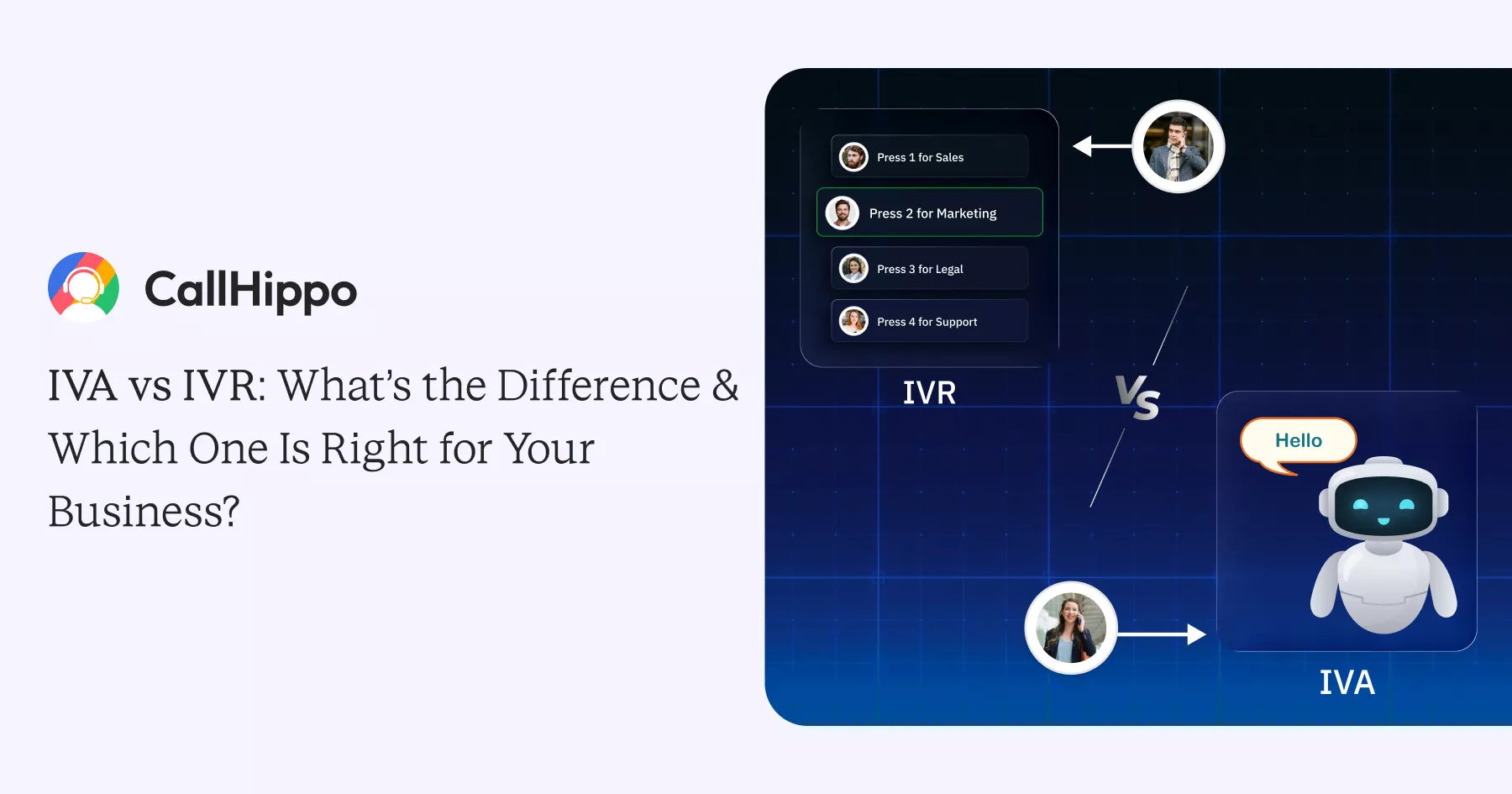
IVR is an automated phone system that interacts with callers using keypad inputs or basic voice commands. It plays a menu. The customer inputs numbers, and the system routes the call.
As the IVR system automates customer calls with the help of menus and prompts, it reduces operational costs and builds authority for businesses. This also frees up the valuable time of human customer service agents.
Example,
- Press 1 for sales
- Press 2 for support
- Press 3 for billing
Interactive Voice Response technology follows a fixed logic. It does not understand intent; it only reacts to options selected by customers.
How does IVR work?
- The caller dials the business number
- IVR plays a menu
- The caller presses a key or says a word
- IVR routes the call based on that input
Where is IVR used?
- Banks
- Airlines
- Telecom companies
- Utilities
- Large customer support centers
IVR is reliable and a predictable option for businesses to allow customers to connect with the correct department or person and provide simple information. It is easy to deploy and works well for straightforward tasks. However, it is crucial to know that it cannot adapt or learn and can only be used to cater to basic inquiries.
What is an IVA (Intelligent Virtual Assistant)?
IVA is an AI-powered intelligent virtual assistant /agent that has natural language understanding. It listens to what the caller says, identifies user intent, and responds conversationally. IVA offers distinct approaches to customer service automation.
It works like a human agent, but faster and at scale. Instead of pressing keys, customers speak naturally. It can solve complex customer queries. For example, if a customer has a technical query, the call center IVA can provide multi-step tech support. It can also offer tailored recommendations by analyzing customers’ history.
Example,
- I want to check my order status
- I need to reschedule my appointment
- I want to speak with sales
IVA understands the intent, retrieves information, and takes action.
How does IVA work?
- The caller speaks normally.
- Speech is converted into text.
- AI analyzes intent and context.
- The system triggers the right workflow.
- Response is delivered back in voice.
IVA uses natural language processing, machine learning, and conversation design. And unlike IVR, IVA improves with data and becomes smarter over time. It also prevents businesses from security breaches and protects customers’ data.

Give Customers Instant, 24/7 Support
Simplify your call center operations with CallHippo’s smarter IVR and IVA
bottom circle
Key Differences Between IVR and IVA
We saw what IVR and IVA are; now, let’s understand the key difference between them. Let’s see the analyses between IVR vs IVA.
| Aspect | IVR | IVA |
|---|---|---|
| Technology | Rule-based menus | Artificial intelligence (AI) and natural language processing (NLP) |
| Customer Interaction | Menus and pre-recorded messages to guide customers | Conversational, the customer just has to convey their query |
| Intent Understanding | None | High |
| Personalization | Low, as it cannot be personalized | High, as IVA can extract data from the CRM platform system to offer personalized support |
| Query Handling | Can manage simple tasks | Can manage complex tasks |
| Scalability | Moderate | Very high |
| Cost-effectiveness and ROI | Lower cost, lower ROI | Higher cost, higher ROI |
Benefits of IVR Systems
IVR is an old tech that still holds a prominent place in today’s work environment. It is widely used by businesses from all sectors. Here is why businesses still use IVR systems.
Benefits of IVR Systems
- Reduces Call Routing Time: IVR routes calls instantly. No human intervention is required. This reduces wait time and speeds up resolution.
- Low Operational Cost: IVR reduces the need for agents to handle repetitive queries. This saves payroll costs.
- 24×7 Availability: IVR works 24/7, enhancing customer service and making it accessible for customers even outside business hours.
- Easy to Deploy: IVR systems are simple to set up. Most cloud platforms offer plug-and-play IVR.
- Improves Call Organization: IVR ensures calls reach the right department. This reduces transfers and misrouted calls.
Benefits of IVA Systems
In comparison to traditional IVR systems, IVA is a more advanced technology designed to cater to the complex needs of businesses.
With the help of advanced AI capabilities, it not only makes things simpler for businesses but also evolves as well over time. Here is why businesses are and should be using IVA systems.
Benefits of IVA Systems
- Natural Conversations: To use IVA, customers only need to speak normally. This improves satisfaction.
- Better First Call Resolution: IVA understands intent and context. It solves more queries without agent involvement.
- Personalization at Scale: IVA remembers preferences. It tailors responses and feels human.
- Continuous Learning: IVA improves with usage and adapts to customer behavior.
- Handles Complex Customer Requests: IVA can book appointments, track orders, etc.
Limitations of IVR
As the technology has advanced, the need for modern solutions has also increased. And IVR might not be able to cater to the unique business needs. Here are a few limitations of IVR.
- Rigid Experience: IVR cannot adapt. If the option is not in the menu, the customer gets stuck. This delivers a bad experience and can even frustrate the customers.
- Poor Customer Experience: Long menus frustrate users. Many even end up abandoning the call.
- No Learning Ability: IVR never improves; it remains static.
- Not Context Aware: IVR does not remember previous interactions.
Limitations of IVA
For businesses, call center IVA is an advanced tech option to make the communications process easy for customers. However, it comes with its own challenges. Here are some of the limitations of IVA.
- Higher Initial Cost: IVA requires AI training integration and data. This increases setup cost.
- Needs Quality Data: Poor customer data leads to poor results.
- May Misunderstand Accents: IVA can struggle with strong accents or noisy environments.
- Compliance and Privacy: IVA must handle sensitive data carefully. Compliance is critical.
IVA vs IVR: Which One Should You Choose?
There is no universal answer; the right choice totally depends on business size, high call volume, and customer expectations. Below is a better understanding of which options should be used and when.
When Should You Use IVR?
- When your call flows are simple
- When the budget is limited
- When customers only need call routing and basic info
- When regulatory control is strict
- When volumes are moderate
When Should You Use IVA?
- When the call volume is high
- When customers ask complex queries
- When personalization matters
- When you want automation beyond routing
- When customer experience is a priority

Pro-Tip
Start with IVR for routing and layer IVA on top for intent handling.
How IVR and IVA Impact Customer Experience?
Customer experience is the factor where the difference between IVR and IVA becomes most visible. Both systems shape how customers feel during every interaction. IVR focuses on basic call routing and customer service efficiency, while IVA focuses on understanding and resolution.
One guides customers through menus, the other guides customers through conversations. This difference changes how fast issues get solved, how much effort customers spend, and how satisfied they feel after the call. Let’s understand better with examples.
Example 1 Appointment Booking
With IVR:
Customers have to navigate a predefined menu by listening to each and every option. Here is how the flow looks like,
- Press 1 for “booking”
- Press 2 for “rescheduling”
- Enter date
- Enter time
This works well for simple bookings. However, if the customer selects the wrong option, they might need to start the process all over again.
With IVA:
Customers only need to say, “I want to book an appointment for tomorrow at 10”. The IVA understands intent and confirms the booking, “Sure, I have booked your appointment”.
IVA is fast, simple, and human-like. It reduces effort and shortens calls.
Example 2: Order Status Inquiry
With IVR:
The process is the same as we saw above; however, the flow differs depending on the needs of customers. Instead of appointment booking, if the customer wants to know the order status, the process can be something like,
- Press 1 for “order-related queries”
- Press 2 for “order status”
- Enter unique order number
- Wait
With IVA:
With IVA, it is simple; customers just need to ask, “Where is my order?”.
By using IVA, customers’ inquiries can be solved easily. Customers do not have to wait for any agent, nor do they have to fill in multiple inputs to get to the solution. All they need is ask their queries, that’s it. Using IVA can significantly improve customer satisfaction.
Example 3: Lead Qualification
With IVR:
IVR can ask structured qualification questions. With IVR, the caller needs to press numbers based on the company size or the interest area.
With IVA:
- Asks qualifying questions
- Captures budget timeline needs
- Routes to the right rep
IVA improves conversion, as it can identify intent, urgency, budget signals, and the buying stage. High-intent leads can be routed immediately to sales, while lower-intent leads can be nurtured automatically.
This increases conversion rates and improves sales efficiency.
Smarter Hybrid Voice Automation: Use IVR and IVA Together with CallHippo
The smartest approach is not choosing between IVR and IVA. It is using both together. CallHippo, an automated telephony system, allows businesses to use IVR for call routing and compliance. Then IVA handles conversation and resolution. This hybrid approach delivers control and intelligence.
Benefits of hybrid automation
- Lower cost
- Better CX
- Higher resolution rates
- Better agent productivity
- Faster scaling
CallHippo also provides analytics, call recording, compliance controls, and global number support. This makes it ideal for growing contact centers.

Elevate Your Customer Experience and Reduce Cost with CallHippo’s IVR and IVA
Take a 10-Day Free Trial No credit card is required!
FAQs
1. What is the main difference between IVR and IVA?
IVR uses menus, prompts, pre-recorded messages, and buttons to interact with customers, while IVA uses AI and natural processing language.
2. Is IVA better than IVR for customer support?
Yes. If your business manages complex customer queries and requires personalization, a call center IVA can be a better option. However, if you only require simple routing, IVR can work fine.
3. Can IVA replace IVR completely?
No, IVA cannot replace IVR completely. IVR is still a widely adopted technology and is useful for routing and fallback. In fact, for call centers that only require basic calling features, IVR is a more suitable option than IVA.
4. Is IVA more expensive than IVR?
Yes initially. The upfront cost of IVA is high in comparison to IVR. But in the long-run, IVA often delivers higher ROI than IVR.
5. Which is better for call centers, IVR or IVA?
Large modern call centers, managing complex customer queries, benefit more from IVA or hybrid models. While small call centers with basic calling needs can use IVR.
6. Are IVA systems secure?
Mostly yes. If the system is built with encryption compliance and proper data handling, IVA systems can be quite safe and secure to use.
Published : January 30, 2026
Harsh Bairagi is a B2B SaaS content writer with over 4 years of experience in the tech industry. Harsh believes in creating good copies to bridge the gap between tech and emotion. When not chasing clean copy or clever metaphors, he is busy catching up on his favorite sports.

Let’s Stay in Touch
Subscribe to our newsletter & never miss our latest news and promotions.
 24k+ people have already subscribed
Source