
 Updated : March 31, 2026
Get an AI-powered summary for this content:
Industry research consistently shows that QA teams manually review just 1–5% of recorded interactions, meaning if your center handles 20,000 calls a month, fewer than 1,000 are ever actually evaluated.
Speech analytics software fixes this. But there are platforms built for enterprise compliance teams, real-time guidance, post-call QA engines, and conversation intelligence that look similar on a feature page but solve completely different problems. So, what and how do you choose?
We compared 15 cloud-based speech analytics platforms and highlighted who it’s built for, and more.
What is Speech Analytics Software?
Speech analytics software uses AI to transcribe and analyze voice conversations, mainly phone calls. A QA manager reviewing calls manually might get through 20 a week. A contact center speech analytics platform processes all of them, automatically, and turns the audio into structured data your team can act on.
Modern speech analytics solutions detect emotion, separate agent and customer voices cleanly, handle multiple languages, and in some cases push guidance to agents while the call is still live.
Types of Speech Analytics Software
Before you evaluate any call center speech analytics software for customer conversations, figure out and gain some actionable insights on which category you actually need.
| Type | What It Does | Best For |
|---|---|---|
| Post-Call Analysis | Processes recorded conversations after the call ends. Delivers QA scoring, trend analysis, agent performance reports, etc. | QA teams, compliance audits, and trend tracking |
| Real-Time Agent Guidance | Listens to calls as they happen and delivers live prompts to agents during the conversation. | Sales teams, regulated industries, and onboarding acceleration |
| Unified Speech Analytics | Combines post-call analysis and real-time guidance into a single platform with connected coaching workflows. | Mid-to-large contact centers |
| Predictive Analytics | Uses ML models to go beyond what happened and forecast what will happen. | Enterprise centers focused on proactive CX and revenue protection |
| Conversation Intelligence | Multi-channel (calls + video + email) with a focus on revenue outcomes, deal health tracking, and rep performance. | B2B sales teams, RevOps, and SDR organizations |
Speech Analytics vs. Voice Analytics vs. Conversation Intelligence
Vendors use these three terms interchangeably, but they are different. Here’s how:
| Term | What It Analyzes | Primary Output | Typical Buyer |
|---|---|---|---|
| Speech Analytics | Spoken audio from calls. Transcribes words, identifies topics, flags compliance issues, and scores agent behavior. | QA scorecards, compliance reports, agent coaching insights, and sentiment trends. | Contact center managers, QA leads, compliance teams |
| Voice Analytics | The acoustic and tonal properties of speech: pitch, pace, volume, hesitation, and emotional tone. | Emotion detection, stress indicators, customer frustration scores, and agent tone analysis. | Customer experience teams, healthcare, behavioral analytics |
| Conversation Intelligence | The full conversation across channels: calls, video meetings, and emails. | Deal health scores, rep benchmarking, objection analysis, forecasting signals. | Sales leaders, RevOps, SDR managers |
Note: QA teams need speech analytics, sales teams need conversation intelligence, and anyone focused on emotional tone and stress signals needs voice analytics to analyze customer conversations.
How Speech Analytics Software Works
This is how speech analytics software works:
Alt Text: Understanding How Speech Analytics Software Works
1. Audio Capture & Ingestion
The platform connects to your telephony infrastructure via API, SIP recording, or a native CCaaS integration and captures call audio in real time or receives recordings post-call.
2. Automatic Speech Recognition (ASR)
Audio is converted to text using automatic speech recognition. The accuracy of this step varies significantly across platforms and is influenced by speaker accents, background noise, audio quality, call transfer disruptions, and domain-specific vocabulary.
3. Speaker Diarization & Separation
The transcription engine separates the conversation by speaker agent vs. customer. This is critical for accurate sentiment scoring and QA evaluation.
4. Natural Language Processing & Analysis
With a clean transcript, the NLP layer applies a range of analytical models: sentiment detection (at the utterance level, not just call level), keyword and topic identification, intent classification, compliance verification, etc.
5. Scoring, Alerts & Coaching Triggers
The platform applies your configured rubrics to generate QA scores, flag compliance violations, surface coaching opportunities, or trigger real-time alerts.
6. Reporting, Dashboards & Integrations
Processed insights surface through dashboards, automated reports, CRM fields, or coaching workflow tools, wherever your team actually makes decisions.
Key Features to Evaluate in Speech Analytics Software
Here’s what to focus on and what to push vendors on specifically.
- Transcription Accuracy: It is the foundation. Probe for multi-language/dialect support, custom vocabulary, and real telephony audio performance.
- Sentiment & Emotion Analysis: Per-speaker, per-moment scoring that tracks when frustration spiked and whether the agent recovered.
- Real-Time Guidance: Sub-2-second latency with live prompts for compliance, objections, and coaching during the call.
- Automated QA: 100% call coverage eliminates survivorship bias and is a prerequisite for AI-ready quality programs.
- Compliance Monitoring: Script adherence, required disclosures, prohibited language flagging, and PCI/HIPAA/GDPR audio redaction.
- Agent Dashboards: Talk-to-listen ratio, dead air, FCR, and empathy markers at the agent, team, and cohort level.
- Integrations: CRM (Salesforce, HubSpot, Zoho) and CCaaS (Five9, Genesys, NICE) for native audio capture without middleware.
- Reporting: Custom dashboards, trend analysis, cohort comparisons, and flexible exports. Rigid pre-built reports create bottlenecks.
15 Best Speech Analytics Software in 2026
Each write-up is based on documented features, publicly available pricing where it exists, and aggregated user feedback from G2, Capterra, and analyst reports.
1. CallMiner Eureka — Best for Regulated Industries and Large Contact Centers
CallMiner Eureka is an enterprise-grade conversation intelligence platform that analyzes 100% of omnichannel interactions, voice, and text using AI and ML to surface coaching opportunities, compliance risks, and CX insights at scale.
Key Features
- Omnichannel interaction capture & transcription
- AI Assist
- CallMiner RealTime
- Automated Quality Management
- Eureka Redact
Pros
- Exceptionally high transcription accuracy is praised by enterprise users.
- Deeply customizable categories, scoring, and reporting.
- Strong customer support and an active community.
Cons
- Reviewers repeatedly flag that becoming truly proficient is time-consuming.
- Slower to adopt generative AI natively than cloud-native competitors.
Pricing
Custom pricing only: no published tiers.
2. Enthu.AI — Best for Small-to-Mid-sized Teams
Enthu.AI is a conversation intelligence platform built for SMB and mid-market contact centers and sales teams. It transcribes and analyzes 100% of calls to surface agent coaching moments, QA scores, and customer insights without requiring full-time QA staff.
Key Features
- Automated call transcription
- AI-powered call moments detection
- Auto QA
- Agent performance dashboards
- Integrations with dialers and CRMs
Pros
- Industry-leading transcription accuracy, consistently ranked as the platform’s top strength.
- Reduces manual QA time dramatically.
- Highly responsive customer success team.
Cons
- Reporting customization is limited out of the box.
- The manual call upload workflow has fixed upload limits.
Pricing
- Custom pricing. Starts at approximately $500/month for up to 100 agents.
- 14-day free trial available.
3. NICE CXone — Best for Enterprise Omnichannel Analytics
NICE CXone Mpower is an enterprise CCaaS platform unifying omnichannel routing, Enlighten AI analytics, workforce engagement management, and automation in a single cloud suite. Suited for large contact centers needing end-to-end CX orchestration.
Key Features
- Enlighten AI
- Omnichannel routing
- Workforce Engagement Management
- CXone Mpower Agent Assist
- AI-powered Virtual Agent Hub
Pros
- Broadest omnichannel coverage in the market.
- One of the most buyer-friendly commercial structures among enterprise CCaaS vendors.
- Deep Enlighten AI capabilities are now bundled rather than sold as costly add-ons.
Cons
- Pricing escalates sharply across tiers.
- Complex initial configuration and a steep learning curve.
Pricing
- CXone Mpower Omnichannel Suite: $110/agent/month
- CXone Mpower Essential Suite: $135/agent/month
- CXone Mpower Core Suite: $169/agent/month
- CXone Mpower Complete Suite: $209/agent/month
- CXone Mpower Ultimate Suite: $249/agent/month
4. Verint — Best for Workforce Management Integration
Verint Speech and Text Analytics is a cloud-based enterprise solution that transcribes and analyzes 100% of voice and digital interactions using AI bots, including sentiment, PII redaction, and topic discovery, natively integrated with its broader workforce engagement suite.
Key Features
- Verint Exact Transcription Bot
- Sentiment Bot
- PII Redaction Bot
- Playback Summary Bot
- Native WFM integration
Pros
- Modular bot architecture allows organizations to activate only the analytics capabilities they need.
- PII redaction is included natively.
- Enterprises with 2,500+ agents use Verint to identify call drivers.
Cons
- Transcription accuracy struggles with non-native English accents.
- Users report open tickets going unresolved for extended periods.
Pricing
- Custom pricing; contact Verint for a quote.
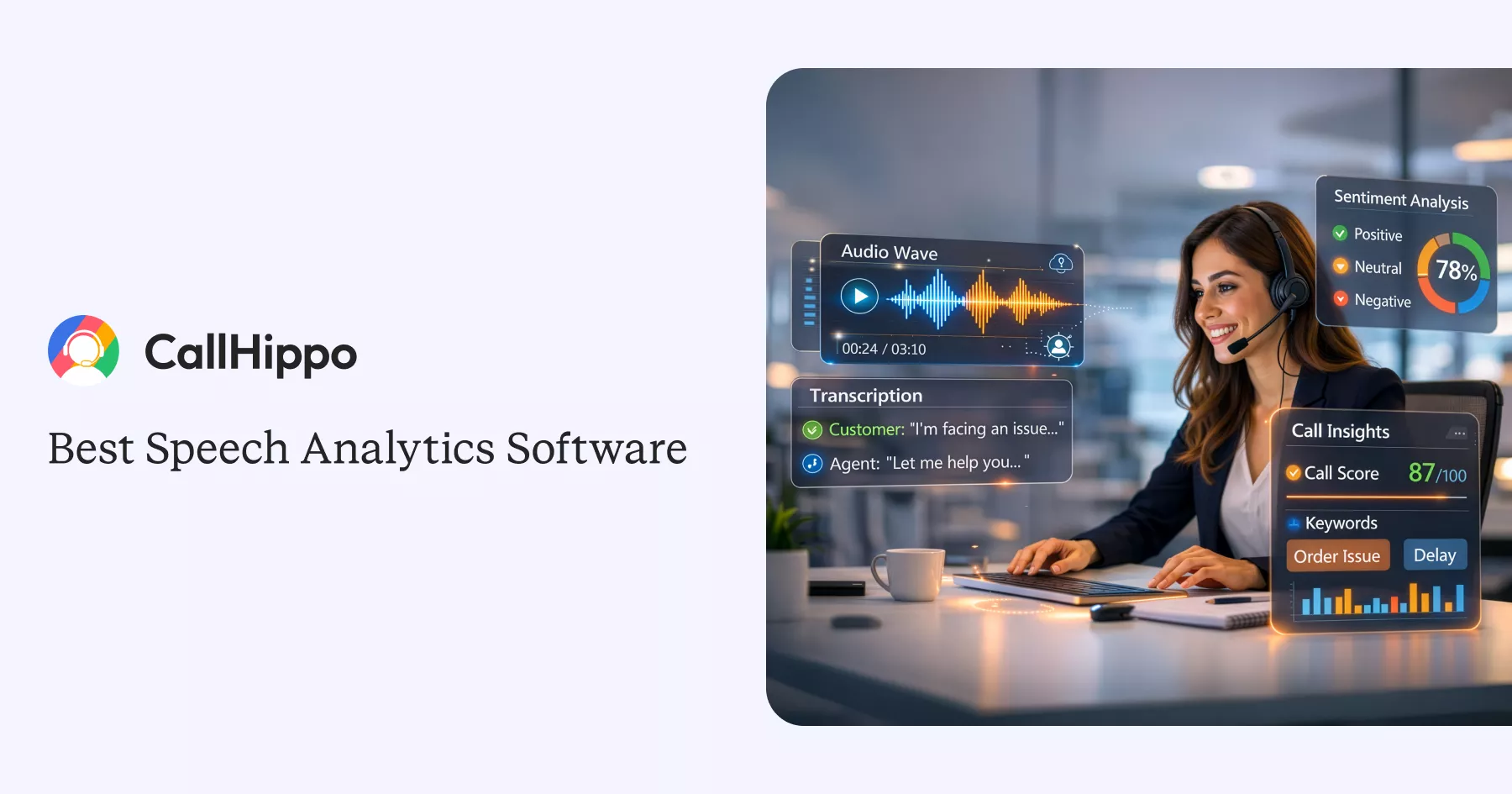
5. CallHippo — Best for VoIP Teams Needing Built-in Speech Analytics with Call Center Features
CallHippo is the speech analytics solution that doubles as a full VoIP phone system, meaning contact center teams get call recording, transcription, sentiment analysis, AI call summaries, and compliance monitoring without a separate telephony stack.
Key Features
- AI Call Summaries & Transcription
- Sentiment Analysis
- AI Copilot
- Compliance Monitoring
- Native CRM Integrations
Pros
- Phone system + speech analytics in one platform eliminates the multi-vendor integration cost and complexity that plagues standalone analytics tools.
- Transparent pricing starting at $1/user/month.
- Broad international reach (50+ countries) with CRM-native integrations.
Cons
- Analytics depth doesn’t match dedicated enterprise platforms teams requiring advanced conversation intelligence.
- AI speech analytics features are an add-on module.
Pricing
- Basic: $1/user/month
- Starter: $19/user/month
- Professional: $29/user/month
- Ultimate: $45/user/month (all billed annually).
- Enterprise: custom quote. AI features (transcription, sentiment analysis, agent performance scoring, compliance monitoring) are available as an add-on. Contact sales for current bundle pricing.
- 10-day free trial available

One platform. Calls, analytics, and coaching: all in.
Skip the integration headache. CallHippo’s AI add-on covers transcription, sentiment, and compliance!
bottom circle
6. Observe.AI — Best for Automated QA at Scale
Observe.AI is an enterprise contact center AI platform combining VoiceAI agents, real-time agent copilot, and post-interaction analytics to automate QA at scale. It is trusted by companies like DoorDash and Concentrix, and it requires a minimum of 100 seats.
Key Features
- VoiceAI Agents
- Real-Time AI Copilot
- Post-Interaction Analytics
- Automated QA with customizable evaluation forms
- AI-powered call summaries
Pros
- Users consistently praise the platform’s ability to capture emotional nuances.
- Dual coverage of human and AI agent interactions in one platform.
- Deep enterprise integrations and a culture of proactive customer success.
Cons
- Minimum 100-seat requirement with annual commitments makes it inaccessible for SMBs.
- Reviewers report implementation taking significantly longer.
Pricing
7. Balto — Best for Real-Time Agent Guidance
Balto is a real-time guidance platform that listens to live calls and visually prompts agents with the right things to say, handling objections, compliance requirements, and playbook steps, as the conversation unfolds. It overlays onto existing phone systems without replacing them.
Key Features
- Real-Time Guidance
- Dynamic script playbooks
- AI call scoring
- Automated call summaries
- Compliance monitoring
Pros
- Customers report a lift in sales conversions and a faster ramp time for new agents.
- Works over 60+ CCaaS and softphone platforms without replacing telephony.
- Consistently high rating with agents themselves praising ease of use.
Cons
- AI occasionally misinterprets speech, triggering incorrect prompts.
- Quote-only pricing with seat minimums and opaque add-on costs.
Pricing
- Custom quote-based pricing; no published tiers.
8. Genesys Cloud — Best for Teams on the Genesys Ecosystem
Genesys Cloud CX is a cloud-native omnichannel contact center platform with built-in speech analytics, AI-powered routing, and workforce engagement tools. Designed for mid-to-large enterprises needing a unified voice, digital, and analytics solution under one license.
Key Features
- Conversational Analytics & Insights
- Predictive Routing
- Agent Copilot
- Workforce Management
- Omnichannel Orchestration
Pros
- Context, history, and routing intelligence are preserved across all 30+ channels.
- Rapid weekly product releases with native AI features included in base tiers.
- Open API and a 350+ AppFoundry marketplace make integration with third-party analytics simple.
Cons
- Telecom charges are separate from licensing.
- Implementation complexity is high.
Pricing
- CX 1: $75/user/month
- CX 2: $115/user/month
- CX 3: $155/user/month
- CX 4: $240/user/month
9. Gong — Best for Sales Conversation Intelligence
Gong is the market-leading revenue intelligence platform for B2B sales teams. It captures and analyzes calls, emails, and meetings to surface deal risks, coaching insights, and forecast signals, helping sales leaders replicate what top reps do differently.
Key Features
- Conversation Intelligence
- Deal Inspection
- Gong Forecast
- Coaching Workflows
- Revenue Analytics
Pros
- The highest-rated conversation intelligence platform for enterprise B2B sales.
- Gong reduces reliance on CRM hygiene for pipeline accuracy.
- Integrates deeply with Salesforce, HubSpot, Outreach, Salesloft, and Zoom.
Cons
- The platform fee jumped to $50,000/year (from $5,000) for Foundations.
- Annual-only contracts with auto-renewal uplift and limited flexibility.
Pricing
No published pricing.
10. AmplifAI — Best for Coaching-driven Contact Centers
AmplifAI is a performance enablement platform for contact center frontline teams. It aggregates agent performance data across WFM, QA, and CRM systems, then uses AI to generate personalized coaching recommendations and gamified motivation, modeled on the behaviors of top performers.
Key Features
- AI-Driven Coaching Recommendations
- Real-Time Performance Scorecards
- Gamification Engine
- Coaching Session Tracking
- Integrations with NICE CXone, Genesys, and 15+ platforms
Pros
- Uniquely bridges performance data and coaching action in one tool.
- Gamification elements demonstrably improve agent engagement.
- Exceptional customer success team with contact center domain expertise.
Cons
- Sentiment analysis is limited.
- New users report a learning curve.
Pricing
- Subscription-based, priced per agent/user. Pricing is not publicly listed.
11. Cresta — Best for Real-time Sales Interventions
Cresta is a genAI-native enterprise contact center platform that provides real-time agent guidance, automated QA, and conversation intelligence. It was born out of the Stanford AI Lab and backed by Sequoia and a16z.
Key Features
- Real-Time Agent Assist
- Cresta AI Agent
- LLMs
- Conversation Intelligence
- Cresta Director
- No-code use-case builder
Pros
- Ranked highest in “current offering” in the Forrester Wave for Conversation Intelligence Solutions, Q2 2025.
- Real-time coaching visibly lifts mid-tier agent performance.
- High ease-of-use scores on review platforms and fast onboarding.
Cons
- The AI model requires significant training on business-specific call methodology before delivering full value.
- Opaque, enterprise-only pricing with no published tiers, accessible only to large organizations.
Pricing
- Custom enterprise pricing only.
12. Convin — Best for Affordable Automated QA
Convin is a full-stack conversation QA platform for contact centers, covering automated call scoring, real-time agent assist, coaching, and AI phone calls. Trusted by Titan and Asian Paints, it supports 70+ languages, including Hindi and Spanish, making it well-suited for multilingual operations.
Key Features
- Automated QA
- Real-Time Agent Assist
- AI Phone Calls
- Convin Insights
- Multilingual Transcription
Pros
- Free quality management system tier availability.
- Exceptionally intuitive UI praised across review platforms.
- Strong CRM and telephony integrations with a genuinely responsive support team.
Cons
- Transcription accuracy for speech-to-text can be inconsistent.
- Occasional dashboard lag and system slowdowns are reported under high-volume usage.
Pricing
- Paid tiers are custom-quoted based on team size, features, and usage.
13. Talkdesk — Best for Cloud Contact Center Native Analytics
Talkdesk CX Cloud is a cloud-native contact center platform with built-in AI-powered speech analytics, quality management, and automation. It offers industry-specific Experience Clouds, pre-built for healthcare, banking, retail, and insurance. It reduces time-to-value for regulated verticals.
Key Features
- Talkdesk Copilot
- Speech Analytics
- Quality Management
- Industry Experience Clouds
- Workforce Management
Pros
- Industry Experience Clouds deliver pre-built AI and compliance workflows.
- Admins can modify routing and automation without waiting for IT.
- Comprehensive reporting with unlimited historical data retention on Elite plans.
Cons
- Recurring reports of call drops, connection instability, and audio quality issues.
- AI features, workforce management, and premium support are reserved for the Elite plan.
Pricing
14. Tethr — Best for Customer Experience Research
Tethr is a CX-focused speech analytics platform that uses machine learning to convert voice into structured intelligence, measuring customer effort, sentiment, churn risk, and agent impact. Strong in academic-grade research-style analysis for customer experience teams in enterprise environments.
Key Features
- Tethr Effort Index (TEI)
- Agent Impact Score
- Customizable Insight Categories
- HIPAA/HITRUST/PCI/NIST Compliant
- Pre-configured Dashboards
Pros
- The Tethr Effort Index is a research-backed metric for measuring customer effort.
- Intuitive interface praised for ease of navigation.
- Users describe quick response times and proactive feedback loops during optimization.
Cons
- Transcription accuracy issues are the most-cited concern.
- Search functionality receives poor marks from a majority of users.
Pricing
Custom pricing only. No published tiers. Free trial available.
15. Chorus (ZoomInfo) — Best for Sales Call Recording and Deal Intelligence
Chorus by ZoomInfo is a conversation intelligence platform for B2B sales teams that automatically records, transcribes, and analyzes calls and meetings. Its key differentiator is deep integration with ZoomInfo’s B2B database, enriching every conversation with firmographic and contact data.
Key Features
- Automated Call & Meeting Recording
- Conversation Metrics
- Deal Intelligence
- ZoomInfo Data Enrichment
- Coaching & Scorecards
Pros
- Contact identification and buying signal detection are automatically layered onto every conversation.
- Reviewers describe it as more affordable and faster to onboard than Gong.
- New-hire training is accelerated by letting reps hear real customer objections.
Cons
- Teams not already invested in ZoomInfo lose most of the platform’s core differentiation.
- Limited customization for keyword/phrase detection.
Pricing
Custom pricing only; sold as part of ZoomInfo licensing.
Speech Analytics Use Cases by Industry
Here’s what speech analytics looks like in practice across the five industries where adoption is deep and where the ROI case is clear.
1. Contact Centers & BPOs
This is where speech analytics delivers the most immediate, measurable ROI. Manual QA at a contact center processing 10,000 calls per month might evaluate 200–500 calls. Automated speech analytics evaluates all 10,000.
2. Sales Teams
Sales performance management has historically run on gut feel and pipeline reviews. Speech analytics gives managers actual evidence: which talk tracks convert, where in the call reps are consistently losing momentum, and what your top performers do differently.
3. Healthcare
For healthcare applications, speech analytics identifies friction in appointment scheduling calls, patient confusion about billing, or emotional distress signals that indicate service failures.
On the compliance side, HIPAA requirements demand that audio data be handled with encryption, role-based access controls, Business Associate Agreements (BAA), and strict data retention policies.
4. Financial Services
Financial services is the compliance-heaviest environment for speech analytics. Speech analytics adds a layer of proactive monitoring: detecting when required risk disclosures are skipped, flagging language that could imply unauthorized investment advice, or identifying potential mis-selling patterns before they become regulatory findings.
5. Retail & E-Commerce
In retail, speech analytics is primarily a customer intelligence tool. It extracts product feedback at scale, what customers are complaining about, what products generate the most confusion, and which promotions are driving inbound calls directly from call audio, without requiring customers to complete a survey.
Speech Analytics Implementation Maturity Model
Before you evaluate any platform, figure out what you actually want. This five-level framework is designed to be used honestly.
| Level | Name | What This Looks Like in Your Org | Recommended Next Step |
|---|---|---|---|
| Level 1 | Manual QA | Random call sampling at 2–5% of volume. QA done via manual listening, spreadsheet scorecards, and subjective supervisor judgment. | Start with a basic transcription tool to build a searchable call library. |
| Level 2 | Keyword Spotting | Automated transcription in place. Basic keyword and topic detection is running. | Deploy a mid-tier tool for 100% call coverage with AI-generated QA scores. |
| Level 3 | Automated QA | AI-scored evaluations running at 100% call coverage. Sentiment analysis, compliance flagging, and coaching triggers are active. | Deploy full-featured platforms with CRM integration. |
| Level 4 | Real-Time Guidance | Post-call analytics are mature. You’re now asking whether you can influence call outcomes during the call. | Add a real-time overlay alongside your existing post-call analytics |
| Level 5 | Predictive & Proactive | Full analytics program in place. The organization is using conversation data to predict churn, trigger automated interventions, and correlate CX performance with business outcomes across channels. | Enterprise unified platforms with predictive ML models and cross-channel correlation. |
How to Choose the Right Speech Analytics Software?
Here’s how to evaluate and choose the right speech analytics software:
1. Start With Organization Size
- Under 50 agents: Mid-tier tools like Enthu.AI and Convin offer strong QA automation and analytics.
- 50–500 agents: You likely need a dedicated analytics platform (Observe.AI, CallMiner) or a CCaaS-native solution (Genesys, NICE).
- 500+ agents: Full-suite enterprise platforms (Verint, NICE CXone, CallHippo, Genesys) with predictive analytics and WFM integration become viable.
2. Clarify Your Primary Use Case
- Compliance-first: Platforms with documented regulatory coverage and real-time compliance monitoring
- Coaching-first: Platforms where QA findings connect directly to agent development workflows
- Sales intelligence: Platforms that connect conversation data to pipeline and deal outcomes
- Affordable all-in-one for VoIP teams: Phone system and speech analytics in a single platform, scaling from SMB to mid-market
3. Audit Your Existing Tech Stack
Before you start evaluating standalone platforms, pull up your current tech stack and identify trends. If you’re on Genesys or NICE, their native analytics layers are worth seriously considering first. If you’re on a VoIP platform that doesn’t include analytics, which is exactly the gap CallHippo addresses with its integrated model, then a dedicated analytics layer makes sense.
4. Get Real About Budget — Including Hidden Costs
Speech analytics pricing is rarely what it appears at the plan level. Common cost layers to probe during evaluation:
- Per-seat scales predictably with team size; platform licensing may create better per-agent economics at high volumes
- Transcription access, real-time guidance, and advanced analytics are often sold as separate line items on top of base plans.
- Analytics platforms generate ROI only when the data changes decisions. That requires training supervisors and QA teams on how to interpret and act on AI-generated insights.
Frequently Asked Questions
1. Can speech analytics work in multiple languages?
Yes. Most enterprise platforms have language lists that stretch to 30–70+ languages, but English accuracy is consistently the strongest among those voice interactions with customers. If you run operations in Spanish, French, Arabic, Hindi, or any regional dialect, test the platform specifically against your call audio before you sign anything.
2. What is the ROI of implementing speech analytics?
ROI stacks from several directions. The fastest wins usually come from QA efficiency: replacing manual sampling with automated 100% coverage saves significant reviewer time while catching compliance failures that random sampling would never surface.
3. How long does speech analytics implementation take?
Dramatically different depending on what you’re deploying. A mid-tier platform like CallHippo or Enthu.AI can be live in days to a couple of weeks for basic use cases; these are built for teams that don’t want to run an IT project.
4. Is speech analytics software compliant with data privacy regulations?
Compliant is a due diligence checklist. For HIPAA: get a signed Business Associate Agreement before anything else. For GDPR: confirm the platform supports data subject rights (access, deletion, portability requests), that audio data stays in GDPR-adequate jurisdictions Before you sign with any vendor, ask for their security documentation and SOC 2 Type II certification, and focus on the customer feedback.
Published : March 20, 2026

Priya Naha is an experienced technical content writer who focuses on VoIP and telephony technologies. Her expertise in telecommunication and content marketing allows her to simplify complex topics with real-world knowledge, making her writing relatable, informative, and easy-to-read. Her direct involvement with VoIP products and solutions makes her a reliable voice in the field.

Let’s Stay in Touch
Subscribe to our newsletter & never miss our latest news and promotions.
 24k+ people have already subscribed
Source